L-Citrulline vs L-Arginine: Which One Actually Raises Nitric Oxide?
Arginine is the molecule your body converts into nitric oxide. So why does swallowing citrulline raise arginine better than swallowing arginine does? The answer is a first-pass problem in your gut and liver.
If you read the back of enough men's supplements you eventually notice something odd. Nitric oxide is made from arginine. Every textbook says so. And yet the products that seem to know what they are doing put citrulline on the label instead. That is not a cost dodge or a fashion. It is a direct response to a problem in your own digestive tract.
The first-pass problem
Swallow a gram of L-arginine and a substantial share of it never reaches your bloodstream intact. The enzyme arginase, abundant in the gut wall and the liver, breaks arginine down before it gets into general circulation. The dose you took and the dose that arrives are two different numbers, and the gap widens as the dose gets bigger.
Citrulline is not an arginase substrate. It passes through that first pass largely untouched, reaches the kidneys, and is converted there into arginine and released into circulation. The net result is the sentence that surprises everyone the first time they read it: taking citrulline raises your plasma arginine more effectively than taking arginine does.
What happens after that
Arginine is the substrate for nitric oxide synthase. The nitric oxide it produces diffuses into the smooth muscle wrapping your blood vessels and relaxes it. Vessels widen, resistance falls, and delivery of oxygen and fuel to working tissue improves. This is ordinary, well-mapped physiology — the 1998 Nobel Prize in Medicine went to the discovery of nitric oxide as a signalling molecule in the cardiovascular system.
None of which tells you that a supplement will do anything for you. A pathway existing is a necessary condition, not a sufficient one.
The two numbers that decide it
Effect in this pathway is a dose story, and there are two doses that matter.
- How much citrulline you take. The research people cite when they sell this ingredient generally works in grams, not milligrams. A few hundred milligrams and a few grams are not the same intervention, and the second is not simply a bigger version of the first.
- How much your baseline was already limiting you. If your endothelial function is fine and your diet already supplies arginine and nitrate, adding a precursor to an unconstrained pathway does very little. Supplements do most of their work at the bottom of a deficiency curve, and healthy men are rarely there.
Why this matters for gummies specifically
A gummy is mostly base. Sugar or a sugar alcohol, a gelling agent, colour and flavour occupy the majority of its mass, which leaves less room for active ingredients than a capsule of the same weight. That is not a knock on gummies — adherence is a real advantage and people take gummies they would abandon as pills — but it is a physical constraint you should hold in mind when a gummy is compared to a scoop of powder from a trial.
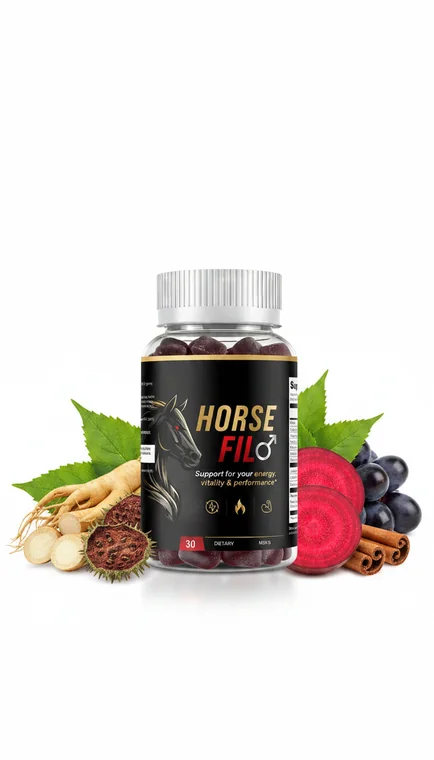
Which brings us to the awkward part. HorseFil names L-citrulline first on its ingredient list and publishes no amount for it, or for anything else. We cannot tell you whether the citrulline in it is at a level the research would recognise, and neither can anyone else writing about it online. The Supplement Facts panel on the physical bottle is the only document that answers the question.
Nitrate is a separate route
One frequent confusion: beetroot and other dietary nitrate sources also raise nitric oxide, but by a different route entirely — a nitrate-to-nitrite-to-nitric-oxide reduction that depends heavily on the bacteria living on your tongue. It is genuinely why antibacterial mouthwash can blunt the blood-pressure effect of beetroot juice. Citrulline does not use that pathway, so the two are not interchangeable and their evidence bases should not be pooled.
What a fair test looks like
If you are going to try a citrulline-containing product, test it the way the mechanism works rather than the way marketing suggests. Take it daily rather than only before sessions. Give it eight to twelve weeks. Change one variable at a time — starting a new supplement in the same week you change your training block tells you nothing about either. And be honest that endpoint you care about, "how the second half of a workout feels", is subjective and moves with sleep, hydration and mood far more than with any capsule.
Two safety notes worth more than the rest of this article
Anything that acts on the nitric-oxide pathway deserves a conversation with a pharmacist if you take nitrates for angina, medication for blood pressure, or a PDE5 inhibitor. These act on the same system, and the interaction question is legitimate rather than theoretical. Separately, if you are pursuing a nitric-oxide supplement because of erectile dysfunction, please see a clinician instead: ED is frequently the first visible sign of vascular disease, and treating it with a gummy means missing the warning.
Where to check this
- NIH Office of Dietary Supplements — Dietary Supplements for Exercise and Athletic Performance, Health Professional Fact Sheet (ods.od.nih.gov)
- MedlinePlus, U.S. National Library of Medicine — herb and supplement entries for L-arginine and L-citrulline (medlineplus.gov)
- National Center for Complementary and Integrative Health — Using Dietary Supplements Wisely (nccih.nih.gov)
These are standing reference resources rather than citations of individual trials. We link you to the bodies that maintain the evidence summaries so you can check the current position yourself, rather than to a snapshot that ages.